Review · 04 Nov 2025
Pentiment
A murder mystery where the point is not who did it but what your accusation costs the town.
DoukaWriter · Horror, adventure, narrative gamesafter 24 hours
Obsidian Entertainment · Narrative adventure · PC · released 15 Nov 2022 · Full playthrough, plus a partial second act on a different accusation
Played 20% longer than the game usually takes to finish.
Tested on Steam Deck OLED · native · locked 60 fps
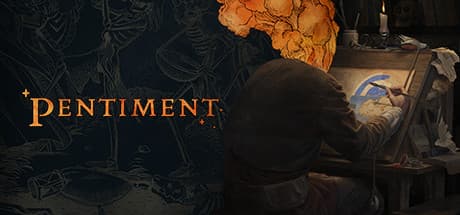
The typography is the first thing anyone mentions and it deserves the attention: every character speaks in a hand appropriate to their education and station, the letters are drawn on as though inked, and mistakes are scratched out and corrected in the margin. It is the most committed visual conceit I have seen in a game and it never becomes decoration, because reading who someone is from how their words look is the same skill the mystery requires.
The accusation is the mechanic
You investigate a murder in a sixteenth-century Bavarian town, you gather what you can in a fixed amount of time, and then you name someone. You will not have enough evidence. You are not supposed to. The game's whole argument is that certainty is a luxury and judgement is a responsibility, and it holds you to your choice for the following twenty hours.
I named the wrong person. The game did not tell me so. It let the consequences accumulate across two more acts — a family broken, a trade lost, a child growing up with a specific grievance — and I did not know for certain until the last hour. That structure would be unbearable in a longer game. At twenty-four hours it is devastating.
- Acts
- 3, across 25 in-world years
- People accused
- 1, wrongly
- Meals shared with townspeople
- Dozens, and they matter
A town that keeps living
The passage of years between acts is the second great decision. Children become adults with opinions about what you did. Buildings change hands. The abbey's politics shift with the wider Reformation, which the game handles with genuine historical literacy rather than costume-drama shorthand.
Where it slips
The middle act sags. Its investigation is structurally identical to the first and the time pressure that made act one tense has been explained, so you spend it optimising rather than panicking. There is also a great deal of walking between the same six locations, and the Steam Deck was where this stopped bothering me.
The verdict
Twenty-four hours and the best-written game reviewed on this site. It is slow, it is entirely text, and it will not fight you at any point. If any of those are dealbreakers, believe them.
Turn on the historical fonts. The plain one is a kindness, not the experience.
Accessibility
- Font can be switched from historical script to a plain readable typeface
- Text speed and auto-advance both configurable
- Timed dialogue choices can be disabled entirely
- Almost entirely text-based, which is both a barrier and, with the font option, unusually flexible
Checked during play, not from a feature list. Tell us what is missing and it gets added.
❦