Review · 28 Jul 2026
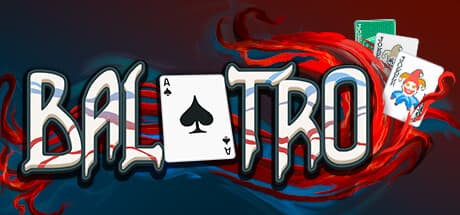
Balatro
A poker roguelike that understands the difference between a good hand and a good decision.
BeeGamesLiteWriter · Indies, roguelikes, handheldafter 61 hours
LocalThunk · Roguelike deckbuilder · PC, Steam Deck · released 20 Feb 2024 · Gold stake cleared on four decks
Played 103% longer than the game usually takes to finish.
Tested on Steam Deck OLED · native · trivially over 60 fps
I have played sixty-one hours of a game with no story, no characters, and a total art budget that appears to be one person and a CRT filter. I am not entirely sure how.
It is not really about poker
The poker framing is a trick to skip the tutorial. You already know a flush beats a straight, so the game can spend its opening minutes teaching you the part that matters instead: chips and multipliers, and the fact that these are multiplied together. A hand worth 30 chips at 4x is nothing. The same hand at 30x is a run.
Everything after that is about building a machine that turns bad hands into big numbers. The best runs I have had were built on high card — the worst hand in poker — because a joker I picked up in the second round paid out for every card that scored.
- Runs started
- 203
- Runs won
- 34
- Longest single session
- 4h 20m
The pacing is the design
Each round gives you three hands and three discards against a target score, and that constraint does more work than any system in the game. Three discards is enough to fix a hand and not enough to fix a plan. You are constantly deciding whether to chase the thing that would win big or bank the thing that will win now, and the answer changes depending on how far into the run you are.
The antes escalate exponentially. The jokers you can buy do not. That gap is where the difficulty lives, and it is tuned beautifully — you almost always lose at the exact point where you can name the two decisions that killed you.
Where it slips
The higher stakes lean on a small set of viable joker combinations, and by gold stake I was making the same opening decisions most runs. That is a familiar roguelike problem and Balatro handles it better than most, but it does arrive.
The other thing worth flagging: this game is engineered to keep you at the table. The runs are short, the restart is one click, and the score is always almost enough. If you have a history of not being able to stop, that is a real thing to know going in.
The economy is the second game
Underneath the poker there is a money system that most players do not read properly for twenty hours. Interest pays out per five dollars held at the end of each round, capped at five interest. Which means that in practice you are not playing for score, you are playing to reach twenty-five banked dollars as early as possible and never dip below it.
Once that clicks, the whole shape of a run changes. Early rerolls become expensive in a way the price tag does not communicate. Skipping a blind for a tag becomes correct far more often than it feels. And the jokers that reward not spending become the strongest in the game despite looking passive.
This is the layer that keeps sixty hours interesting after the combos stop surprising you, and it is the reason the higher stakes are hard — they do not make the hands harder, they make the money tighter.
The verdict
It costs less than a sandwich and I got sixty hours out of it. The design is small, sharp and finished — nothing here is padded, nothing is waiting for a roadmap. Buy it on a handheld if you have one.
Accessibility
- Reduced motion and reduced flashing toggles built in
- Card text scales with a UI slider
- One-handed play viable throughout
- No screen reader support
Checked during play, not from a feature list. Tell us what is missing and it gets added.
❦
Read next
 Manor Lords55 hours · 25 Jul 20266.9